Tuesday, March 13, 2018

Winter War


During the winter of 1939-40, the Finns fought the Soviet Union in an epic struggle for Karelia, the outcome of which can only be called miraculous.

The history of Karelia has been one of frequent warfare. A glance at a map will show why. The Karelian isthmus which lies north of St. Petersburg (Leningrad) and surrounds Lake Ladoga occupies a position not unlike the Holy Land in the Middle East. It is at the end of the Baltic Sea. Control of this land dominates the trade routes which head South and East to the Orient. The Karelian coat of arms reflects this. It shows the curved sword of the East opposed by the straight sword of the West over a large crown.

From about 1200 AD on, Finland had been controlled by Sweden. In the 18th century the Tsars had made several forays into Finland and taken parts of Karelia. A secret agreement at Tilst between Napoleon and Alexander I of Russia gave the Tsar a free hand in the conquest of Finland, and in 1809 he exercised that option by taking the entire country. It was renamed the Grand Duchy of Finland.

Until the assassination of Alexander II in March 1881, Finland had been an autonomous part of the Russian Empire. She had her own language, parliament, armed forces, military conscription and coinage. Laws were passed which discriminated against Russian Orthodoxy in favor of Lutheranism and clearly favored non-Russian citizens. In 1891 a reaction to this practice became Russian policy with the declaration of Russian as the official language. In 1898 NI Bobrikov was appointed governor general of the Duchy. Bobrikov's style was uncompromising. Everything was to be subservient to Mother Russia. In 1901 Finland's legislature was stripped of its power, and in 1902 her independent armed forces suddenly found themselves an extension of the Tsar's army. Young men were conscripted to fight the Tsar's wars. The press was controlled and direct petitions to the Tsar were ignored. However, on June 16, 1904, Bobrikov was assassinated and a spirit of revolution swept the land. This was followed by a number of events throughout the Russian Empire which eventually brought down the monarchy.

On December 6, 1917, Finland declared its independence and fought its own version of the "revolution" in a civil war in which White forces under the leadership of Carl Gustav Mannerheim prevailed over Red Army. For 20 years, Finland, like others, had neglected its military despite warnings from Mannerheim. After World War I, Finland had been given control of the Åland Islands by the League of Nations and with the consent of Sweden with the understanding that no military forces were to be stationed on them.
With the rise of Hitler in 1933 and the ever increasing military build-up by Germany under Hitler and finally the acquisition of territories starting in 1938, Molotov and Stalin, himself, began secret negotiations with a few Finnish representatives in an attempt to force the Finns into giving up control of the Åland Islands, Hanko and other strategic islands in the Baltic plus a large strip of land to the north of Leningrad in return for indefensible parts of Soviet Karelia. However, the Finns could not do this without violating their trust with other Scandinavian countries and the League of Nations.

Hitler looked for any excuse to retake Poland which had been lost by Germany during World War I. In order to secure his Eastern frontier from attack from Russia which also had designs on parts of Polish territories, lost during World War I, Stalin and Hitler signed a "non-aggression pact." It included several secret agreements. It gave Germany the right to take all of Poland except the four Eastern-most counties. These, plus the Baltic States and Finland were to be given to Stalin, if he could take them.

On September 1, 1939, German troops crashed across the Polish frontier in a blitzkrieg and took Poland in a matter of weeks. Stalin's troops moved into the Baltic States and eastern Poland with ease. On November 26, 1939 a border "incident" at Mainila, which even the Russians did not believe, took place.

On November 30, 1939, it was Stalin's next move. 250,000 Russian troops under the cover of a coordinated air and artillery bombardment crossed into Finland to begin one of the least publicized and most costly campaigns in the annals of military history. It would be a "walk over;" General Meretskov estimated it would take only 10 to 12 days for his 26 well equipped 14,000 man divisions to reach Helsinki. Russian propaganda had been so convincing that it was felt that the Finns would be waving flags and welcoming the Red Army with open arms. Opposing him were nine poorly equipped 11,000-man Finnish divisions.

Meretskov never suspected that his army was about to plunge into a frozen hell, the second coldest winter since 1828, and oppose Mannerheim, probably one of the greatest defensive tacticians since Robert E. Lee. So confident were the Soviets of a quick victory march to Helsinki that they came with parade bands, but without winter uniforms, without supplies for a protracted campaign and without medical services. Even more sinister was the fact that Stalin had purged most of his regular army officers two years earlier and placed most of the responsibility for the army in the hands of political commissars.

For 105 days the world held its breath and learned the word sisu, while Russians died at the incredible rate of nearly 10,000 per day and the Finns lost 250 per day. When the armistice finally came on March 13, 1940, the Finns counted 25,000 dead, 55,000 wounded, and 450,000 homeless, a terrible price for a country of only four million people. However, even the Finns did not know the devastation that they had caused the Russians until years later. All this was at the hands of an army of less than 250,000 (mostly light infantry, home guard units) with hardly any anti-tank weapons (except Molotov cocktails) and 41 operational fighter aircraft. In the words of my father-in-law, Antti Olavi Pönkänen, who fought in this war: "Our lakes are full of dead Russians."

The Russians attacked in company, battalion and regimental strength across frozen lakes, their dark uniforms easily visible against the white snow. Machine guns enfiladed the lakes and home guard troops, most of whom were expert shots, armed with one of the best military rifles ever made, the Sako Arms version of the Russian rifle, picked them off one by one. One Finnish soldier, Corporal Simo Häyhä was credited with more than 500 known kills.

One of the most famous early battles of the Winter War occurred at Suomussalmi during December, 1939. The Russian 44th Division advanced along the Raate Road from the south and the 163rd Russian Division advanced from Juntusranta from the North. They were supposed to link up at Suomussalmi and then head West across Finland to Oulu and cut the country in half. Russian troop strength totaled 48,000 men, 335 cannon, 100 tanks and 50 armored cars. The Finnish defenders reinforced from a few thousand now numbered 17,000 with 11 cannons under the command of Colonel Hjalmar Siilasvuo; his only hope was to defeat the Russians in detail. And he did.

To slow down the 163rd in the north, Finnish ski troops made wide circling flanking movements of 20 to 30 miles under cover of the long night and caught the rear and middle parts of the column by surprise. They found Soviet soldiers huddled around fires in -40° weather easy prey to sub-machine gun fire and grenades. Almost any wound was fatal. As the 44th approached Suomussalmi down the Raate Road, they had to pass between Kuomasjärvi and Kuivasjärvi on a narrow isthmus. 350 Finns in hand-to-hand combat closed the isthmus. Trees were now felled across the road in front and behind with the 44th Division strung out along the road. The 163rd only six miles north engaged in desperate struggles to push the Finns west, but were stopped. Much of this fighting was hand to hand. After four days, both the 163rd and 44th were stopped dead in their tracks. Now Russians of the 163rd Division, after throwing their weapons away made an attempt to escape back to Russia. Two Finnish machine gun platoons and a guerrill a company helped them back to Russia. 

The 44th fared even worse. Trees blocked the roads which prevented movement. The frozen lakes around them were death traps. Any attack across the lakes were met with machine gun fire. The Russian dead were permitted lie frozen in the snow over the lakes until the thaw when their bodies sank to the bottom. Several attacks by the Finns further demoralized the Russians. Orders from the commanding general did not permit a fighting retreat. The 44th was out of food, freezing and had nowhere to go except to sit and be slaughtered at will. Of the 44,000 only 5000 made it back. The Finns captured intact 85 tanks, 437 trucks, 20 tractors, 10 motorcycles, 1620 horses, 92 artillery pieces, 78 anti-tank guns, and 13 anti-aircraft guns plus thousands of rifles, machine guns and a horde of ammunition. This was later used against the Russians in Karelia.

In the Karelian isthmus, Russian units were isolated from each other into motti, "log piles." There, surrounded, they froze and starved to death by the thousands or died by rifle fire and wounds. However, the Russians continued to reinforce in the South and keep the pressure on the Finnish line.

As 1940 came, it was apparent to Stalin that his armies were suffering terrible losses; he was getting nowhere fast and knew that Finland had to be beaten at all costs. The British and other nations offered token forces and supplies for Finland, but the Swedes refused transit. Hitler made immediate plans to invade Norway and Denmark while these two countries declared themselves "neutral." Swedish diplomats pointed out that "When great powers are waging war, small countries can't afford to be heroic." This was the thanks Finland got for honoring her commitments to her neighbor, Sweden. Stalin demoted or shot most of the commanders and placed the entire operation in Finland under the command of Marshal Semyon K. Timoshenko. 

Timoshenko ordered large numbers of reinforcements into Western Karelia. According to Khrushchev, Stalin was "gnashing his teeth," waiting for news. "Our air force has been called into action. Many bridges have been destroyed. Many trains have been crippled . . . The Finns have only their skis left. Their supply of skis never runs out."

Blanket bombing began on February 1, 1940, to soften up the lines. The Russians massed 600,000 men, artillery lined hub to hub and poured over 300,000 shells in one day on the Mannerheim Line's Summa positions. In 1.6 miles of front there were 440 cannon pounding the Finns who replied with only 16. Six divisions supported by 500 aircraft and many tanks attacked at the Hatjalahti and Muolaa Lake sectors. The Finns pushed them back. Entire Russian Divisions were wiped out, but more kept attacking over the frozen bodies of their comrades.

The main and final attack of the war began on February 6, 1940, along a five-mile front in Western Karelia with three divisions supported by 150 tanks and 200 airplanes. The results were the same with thousands of dead Russians lying in front of the Finnish positions and more Russian troops charging across their frozen bodies. On 11 February the Russians managed to make breakthroughs on both flanks (Lake Ladoga & Gulf of Finland). Finnish troop strengths were down to one half or one third of original and the Finns were nearly out of ammunition. They were now withdrawn on February 14 to new defensive positions. The Russians made no effort to pursue them.

By February 26, the Finns were forced to abandon Koivisto and they retreated back toward Viipuri. The need for men, arms and ammunition was desperate and Mannerheim warned the Finnish government about the potential consequences. The French and British were offering to send 100,000 men, but should the Finns accept this aid which was not at all certain, go it alone, or try to work a deal with the Russians? The offer from the Allies was suspect and the Swedes were not of a mind to permit them to cross their country. The British and French were also fearful of Hitler's designs on Norway and Denmark and might use the troops there. The German government advised the Finns to make arrangements with the Russians. The Finnish Foreign Affairs Committee again asked Sweden if they would allow transit of Allied troops and Mannerheim asked the United States to mediate. On March 5, Stockholm informed Helsinki that the Cabinet had decided to let no troops cross Sweden by a unanimous vote.

On March 6, 1940, a Finnish delegation left for Moscow to discuss terms. The Finns prepared for another counter-offensive, and the Russians brought up more troops, but all was quiet. In some sectors of the line there were only a few Finns left where there had been whole units, and there was precious little ammunition. Then on March 13, 1940, it was all over; an armistice was signed. Had the Russians mounted just one more attack, they might have carried it all the way to Helsinki, but they had lost their nerve about the same time the Finns ran out of ammunition.

Under the treaty, Russia received Finland's second largest city, Viipuri, the port of Petsamo on the Arctic Ocean, the Hanko area, all of Lake Ladoga’s shores and the entire Karelian Isthmus, the home of 12 per cent of Finland's population. Finland gave up a total of 22,000 square miles. One Russian general remarked, "We have won enough ground to bury our dead." Khrushchev wrote, "Even in these most favorable conditions it was only after great difficulty and enormous losses that we were finally able to win. A victory at such a cost was actually a moral defeat." According to Khrushchev, 1.5 million men were sent to Finland and one million of them were killed. 1000 aircraft, 2300 tanks and armored cars and an enormous amount of other war materials were lost.

The people in the ceded area were given the right to remain with the Soviet Union or emigrate to Finland. Most if not all of the 450,000 people living in the region moved to Finland despite being left destitute and homeless.

The most famous weapon of this brief war is well known—the Molotov cocktail, named after the perfidious Russian negotiator. However, its origin, an invention of the Finnish Liquor Board, is generally unknown. With hardly any anti-tank weapons, four-man Molotov cocktail crews destroyed nearly 2000 tanks. The Soviet tanks had an extra 50 gallon gas tank on the back end of the tank near the engine air vents. The tanks were noted for their poor maintenance and excess grease and oil in the engine compartment. The tank would be allowed to penetrate the tactical wire. One man with a log would attempt to jam the tracks while the two Molotov Cocktail men would throw their weapons on the back end of the tank. The gasoline and alcohol would drip into the engine compartment where heat would ignite the mixture and the engine compartment would burst into flames. This would in turn ignite the 50 gallon gas tank on the back of the tank and create tremendous heat inside the tank. The tank crew would attempt to escap e and the man with a sub machine gun would kill the crew. Casualties among the Molotov cocktail crews were about 75 per cent.

The Winter War of 1939 is a footnote in most histories. Yet it had great importance in the outcome of World War II. Hitler watched as the Finns humiliated the Russians and believed that Germany could crush his Eastern neighbor. Although publicly claiming a great victory, Stalin realized that it had been a military fiasco. He reinstated many Army officers, returned their rank and privileges and reduced the importance of political commissars. His reorganization was just in time to prevent Hitler from taking Russia. Timoshenko said, "The Russians have learned much in this hard war in which the Finns fought with Heroism." Admiral Kuznetsov concluded, "We had received a severe lesson. We had to profit by it." Khrushchev summed it up, "All of us—and Stalin first and foremost—sensed in our victory a defeat by the Finns. It was a dangerous defeat because it encouraged our enemies' conviction that the Soviet Union was a colossus with feet of clay . . . We had to draw some lessons for the immediate future from what had happened."

As for the Allies, Prime Minister Neville Chamberlain's British government and the French government of Daladier vacillated in indecision during the "mid-winter madness" of the "phony war" of 1939-40. The Nazis invaded Norway and Denmark and both governments fell. Pierre Laval took over in France to no avail, but Chamberlain's "peace in our time" policy was replaced by the resolute Winston Churchill. Once Hitler attacked the Soviet Union in June of 1941 and Japan attacked the US in December of 1941, the US, Britain and Soviet Union were thrown together as allies and this spelled doom for the Axis powers in what became one of the true holy wars of world history. 

This epic Finnish Winter War is the material of heroic ballads passed down to generations. Only the hand of God could have brought about the results.


Finland at War


"Finland did not capitulate!"
by Paul Sjöblom


Myths die hard. One such myth, clung to tenaciously abroad, is that Finland "capitulated" to the Red Army in World War II.

"Finland did not capitulate!" ex-president Mauno Koivisto once again emphasized in a recent public appearance.

He spoke at a seminar held in early August in the North Karelian city of Joensuu to celebrate the 50th anniversary of the Finnish victory in the crucial battle of Ilomantsi. Two attacking Red Army divisions were decimated in that last major engagement on the Finnish front before the Armistice concluded in early September 1944.

The future Finnish president witnessed that battle as a soldier in a reconnaissance company commanded by the legendary war hero Captain Lauri Törni (who became a legend also later on in U.S. uniform as a Green Beret under the name Larry Thorne).

In the summer of 1944, when the Red Army launched an all-out offensive aimed at eliminating Finland, the Finns were "extremely hard-pressed," Koivisto declared, but they "did not capitulate."Time and time again, he said he has had to correct this misconception in discussion with foreigners. "We succeeded in stopping the enemy cold at key points," he said, "and in the final battle at Ilomantsi even in pushing him back."

Military historians note that the two elite Red divisions were completely routed after a week and a half of fighting, leaving behind over 3,000 dead, 94 pieces of heavy artillery, a half dozen rocket launchers and the rest of their ordnance. Moscow could only decide that the Finns had plenty of light left in them and would never accept an unconditional surrender.

The Canadian-born Finnish-American scholar Leo Vuosalo, who moved to Helsinki this summer after selling his house in California, fought in this battle as a young recruit. Returning to America after the war, he studied at several California universities and a wrote a thesis dealing with the campaigns on the Finnish front. For the next 35 years or so, he taught courses in history and political science at various universities and other educational institutions in California.
"My academic colleagues," he recalls, "persisted in propagating the myth of Finland's capitulation. They obstinately refused to accept the facts I presented to prove they were wrong."

He sites the case of a Stanford University history professor named Kennedy who wrote much-used textbook dealing with U.S. foreign policy in which Finland gets a passing mention as having been "flattened" by the Red Army. In quite a recent edition of the book, this gross distortion of historical fact remained uncorrected.

Last year, I received an inquiry from a Finnish-American friend about Larry Thorne, whose exploits, he said, had been featured in a movie about the Green Berets. My friend wanted to know whether Thorne had actually, as he had heard, been a popular war hero in Finland, too. Included in the letter was a copy of an official U.S. military biographical sketch of the fellow. This document jolted my by stating that Thorne had been obligated to flee West for fear of Communist reprisal after Finland's "capitulation."
. . .

The ignorance of even the best-informed observers in the West about Finland's part in World War II is astounding.

Take British Major-General H.M. Tillotson's book Finland at Peace & War--1918-1993, for example. It was written, in close collaboration with Finland's Foreign Ministry, Ministry of Defense, Defense Staff, Commission of Military History, Military Archives and Military Museum, to mark, in 1993, the 75th anniversary of the armed forces in independent Finland.*)

Yet, in its 354 pages, the book has room for only one sentence about the single most important battle, perhaps, fought in Finland's Continuation War, Tali-Ihantala. There the Finnish concentration of artillery fire was the heaviest in the country's military history. It has been described as even heavier than the Soviet fire in the siege of Berlin.

The Soviet offensive on the Karelian Isthmus was launched just at the time of the Western Allies' landing at Normandy. The several armies hurled against Finnish fences were crack troops, the Soviet "elite." Stalin's plan was obviously to occupy Finland before the Wester Allies could advance very far against the German lines.

For every 100-meter stretch of the Isthmus, the Red Army placed no less than 10 pieces of artillery--in one sector all of 400 over a distance of only one kilometer. Since the Finns had only 268 cannon, they could mount only 5 for every kilometer. The artillery odds were thus 20 to 1 in the attacker's favor. Besides, with some 400 bombers and 600 fighters thrown into the fray, the Soviet forces had overwhelming air superiority. Official Russian records reveal that during the summer offensive, aircraft of the 13th Soviet Air Force carried out "more than 9,000 combat missions" against the Finnish forces.

The artillery fire aimed at Finnish targets has been described by some researchers as the most massive in world military history up to that time.

At the critical Ihantala sector, however, the Finnish defenders managed to concentrate their fire to the extent of smashing the advancing Soviet spearhead.

In the Russian book Bitva za Leningrad 1941-1944 (The Battle of Leningrad) edited by Lt.-Gen. S.P. Platonov, it is stated: "The repeated offensive attempts by the Soviet Forces failed . . . to gain results. The enemy succeeded in significantly tightening its ranks in this area and repulse all the attacks of our troops . . . During the offensive operations lasting over three weeks, from June 21 to mid-July, the forces of the right flank of the Leningrad front failed to carry out the tasks assigned to them on the orders of the Supreme Command issued on June 21st."

It was then that Stalin ordered the withdrawal from the Finnish front of the decimated elite divisions to join the forces advancing on Berlin.

In a speech held Sept. 4, this year, on the occasion of the 50th anniversary of the signing of the Armistice ending Finnish-Soviet hostilities, Prime Minister Esko Aho declared:

"I do not see defeat in the summer's battles, but the victory of a small nation over a major power, whose forces were stopped far short of the objectives of the Soviet leadership. Finland was not beaten militarily . . .

"Finland preserved her autonomy and her democratic social system . . .

"Finland was on the losing side of the war, but won the peace."
Significantly, aside from Britain, Finland was the only European country involved in the war west of Russia that was never occupied by enemy troops.
_________
*) The all-out support given the British general by the Finnish military authorities is pointed up by the fact that the Preface to his book was contributed by Admiral Jan Klenberg, who is there titled "Commander-in-Chief," though that title belongs in peacetime to the President of the Republic. The commanding officer of the Finnish Defense Forces praises the book, stating that it "has a central role in illustrating the history, the present time and the future of the national defense of Finland for foreigners." This makes it all the harder to understand how Tillitson's book fails to recognize the momentous significance of the Finnish victories in the battles of Tali-Ihantala and Vuosalmi, which halted the massive offensive of 1944 and won for Finland a negotiated armistice and saved the country from enemy occupation.


Friday, December 22, 2017


“We, a Number of Spiritually

 Sensitive Scholars

 from East of Palestine, Are...”


A couple of aporetic questions have led to apocryphal answers...
Liisa Berg


"And when they were come into the house, they saw the young child with Mary his mother, and fell down, and worshipped him: and when they had opened their treasures, they presented unto him gifts; gold, and frankincense, and myrrh." 
(Matthew 2:11)

<<<<*>>>


Not that art will lead us to truth and light—sometimes far from it—but it has been interesting to consider new “takes” on the Christmas Story by examining some masterpieces whose inspiration has flown from the Greatest Story Ever Told. (When I refer to artwork, it is not to look for evidence, just intellectual stimuli.) Fortuitously, there are some known facts that play a role here, too... I just find this very interesting.

“We three kings of Orient are...” might need to say “We a number of spiritually sensitive scholars from east of Palestine are...” These “distinguished foreigners” are better known as the Magi. Magi is the plural of magus, used since at least the 6th century BC, to denote followers of Zoroastrianism or Zoroaster. (But that’s another story.)

How many magi were there? 
Traditionally, it is believed that there were three men, based on the number of gifts brought: gold, frankincence and myrrh. Perhaps there were only two or more than three, bringing communal offerings? (In Eastern Christianity, especially the Syriac churches, the Magi often number twelve.) If they were serving in the capacity of witnesses, there would of necessity have been two or more. (Parts collected from Bible Dictionary.) 

Who were they?  
Who these men were we are not told, but it is certain they were not ordinary men, but nowhere in the Gospels does it say that they were “kings.” That they were privileged to search out the Son of God and give Him gifts, and that they were spiritually sensitive and knowledgeable, suggest that they were actually prophets on a divine errand. The customary identification of them as astrologers is a gross misrepresentation. They evidently were holy men from a land east of Palestine. (Parts collected from Bible Dictionary.)  

How did they travel?  
Did three kings come to see Jesus riding camels? The Bible does not say that any kings or camels visited the young Jesus. Nor does it say that there were horses, though in many Medieval/Renaissance art pieces, horses accompany the magi more frequently than camels. (Those Arabian horses are well-known for their unmatched endurance riding.) (See artwork.) 


Adoration of the Magi
Francesco Bassano, the Younger, Italian, 1549-1592
My favorite. I love the movement/motion in the painting...
Shows a horse (and a donkey, but I can't imagine
the magi traveled on donkeys).


However, in his Adoración de los Reyes Magos, El Greco (1541-1614) painted creatures that to me seem an odd mix of camels and horses. His assertion might have been that he believed the magi did travel by camels, but he added an unexpected "mutation" to their appearance. I don't know. The animals just look odd to me.


Adoración de los Reyes Magos, El Greco (1541-1614)
This painitng also clearly shows that the manger is history and that
the Holy Family is residing in a "house."


When did they visit Jesus?
From the scriptures, we can safely determine that the magi did not visit Jesus when he was still lying in the manger, as is commonly shown on greeting cards and in plays. The magi did not arrive until sometime after Christ’s presentation in the Temple in Jerusalem (Luke 2:22-39). At this time, scripture calls Jesus a “child,” not a “baby,” and that he was in a “house.” It is possible that little Jesus was walking and talking by then, and he could have been up to two years old. (See artwork.) 
Adoration of the Magi
Shows a horse and a baby who is already sitting


Adoration of the Magi (1423)
Gentile da Fabriano, Italian, 1370-1427
Several horses and a baby sitting in his mother's lap.

These two also show a little older "child":

Adoration of the Magi
Domenico Tintoretto, Italian, 1560-1635


Adoration of the MagiGaspare Diziani, Italian, 1689-1867
More grown-up baby, possibly already walking.
..

Another detail: all artwork shows Joseph hovering over Mary and Jesus, though the scripture mentions only Mary as being present with Jesus. 

What did they bring to the Child Jesus?
The Bible story mentions three gifts (and this may be the basis for thinking that there were three visitors): gold, frankincense and myrrh. These three gifts had a spiritual meaning: gold as a symbol of kingship on earth, frankincense (an incense) as a symbol of deity, and myrrh (an embalming oil) as a symbol of death. This dates back to Origen in Contra Celsum: "gold, as to a king; myrrh, as to one who was mortal; and incense, as to a God." (From Wikipedia)

This is what frankincense and myrrh look like, crystalized. When we lived in Riyadh, I found these in one of the many suqs (markets) there. The merchants were sitting around and chewing on the crystals like gum, and gave me a taste. Well, pretty tasteless, actually... Oh, and the gold was hanging around my neck!


Both frankincense and myrrh are resin from trees, frankincense from Boswellia trees, and myrrh from small, thorny tree species of the genus Commiphora. Myrrh can also be ingested (or used as chewing gum!).

It was customary for Saudi women to stand over an incense burner and allow the whiffs to permeate their clothing before leaving the house. It was very pleasant to shop along with these ladies because of the strong fragrance of incense.

An incense burner from perhaps more illustrious times;


More common burners look like this:


So, there’s our legend of an event at an unspecified point after Christ's birth in which an unnumbered party of unnamed "wise men" visit the Christ child at an unnamed location. But I believe.

Thursday, December 7, 2017

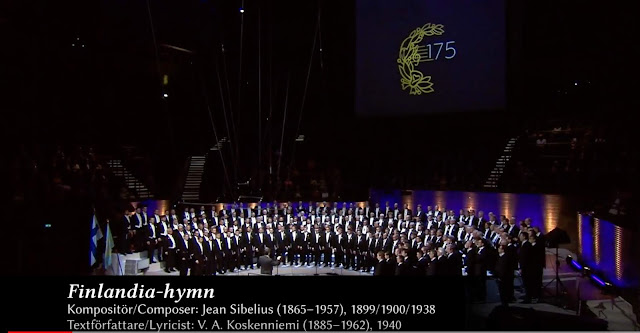
Oi Suomi, katso


Oi Suomi, katso, sinun päiväs koittaa
Yön uhka karkoitettu on jo pois
Ja aamun kiuru kirkkaudessa soittaa
Kuin itse taivahan kansi sois
Yön vallat aamun valkeus jo voittaa
Sun päiväs koittaa, oi synnyinmaa

Oi nouse, Suomi, nosta korkealle
Pääs seppelöimä suurten muistojen
Oi nouse, Suomi, näytit maailmalle
Sa että karkoitit orjuuden
Ja ettet taipunut sa sorron alle
On aamus alkanut, synnyinmaa

V.A. Koskenniemi

~~~~~

Oh, Finland, behold, thy day now is dawning,
The threat of night has been dispelled.
The skylark calls across the light of morning,
As if the firmament itself reverberates.
The light of day now conquers the powers of night
Thy day is dawning, Oh, Fatherland!

Oh, arise, Finland, raise up high
Thy head crowned with grand memories.
Oh, arise, Finland, thou hast shown the world
That thou hast thrown off slavery,
And not succombed beneath oppression's yoke.
Thy morning has commenced, Oh, Fatherland!

~~~~~


Growing up in Finland in the middle of last century, every child understood the sacrifices that our armies had made to leave us a free, independent homeland. Much of the teaching came from patriotic music: songs that we knew by heart from first grade on. One such "musical teacher" was Jean Sibelius' tone poem Finlandia, or Suomi. Oh, the thrill and fervor even the youngest heart felt right from the first discordant measure of the majestic orchestral sound. And then, after the battle of the brass, as if echoing the sounds of war, a calm, reassuring harmony made way for the resolution of conflict that would end the long-lived oppression. This is why every Finn beams with patriotism when he hears this majestic music.


Originally, there was no text to the hymn section of Jean Sibelius' Finlandia; for 40 years Sibelius successfully resisted attempts of many to write such libretto. Finally, in 1940, Veikko  A. Koskenniemi’s creation was acceptable to Sibelius, and the nod was given to go ahead and officially include the poetry. The events in Finnish history lead to this text and its acceptance by the Maestro.

1940 was a seminal time in Finland’s history. On 30 November 1939, Russia invaded Finland, and thus commenced the infamous Winter War (three months after the outbreak of World War II). Finland fought courageously in the freezing winter weather, and the enemy was no match in the snowy fields of Finland. The conflict ended with the signing of the Moscow Peace Treaty on 13 March 1940.

At this noteworthy moment, the culmination of Finland’s strivings for complete independence, Sibelius and Koskenniemi combined their artistic strength resulting in the declaration of victory, “Thy morning has commenced, Oh, Fatherland!”

It may also be important to note the original occasion for which Sibelius composed his tone poem Finlandia—the Press Celebrations of 1899,  a covert protest against increasing censorship from the Russian Empire. The symphonic tone poem was the last of seven pieces performed as accompaniment to tableaux depicting episodes from Finnish history. Sibelius’ composition caused passionate patriotism to the point of raising riots, which lead Russia to ban its subsequent perfomances. However, Finlandia was included in concert programs under various alias titles.

Most of the tone poem is taken up with rousing and turbulent music, evoking the national struggle of the Finnish people. Towards the end, a calm comes over the orchestra, and the serenly melodic Hymn is heard. It still arouses strong patriotic feelings in Finnish hearts.

I hope the reader will understand why it is hard for me to hear the hymn section set to foreign words, and why this is the only way this beautiful hymn ought to be heard:


Sunday, August 7, 2016

BRIDGES OVER PIELISJOKI


It all looks so small now, viewed from the distance of several decades, but a large portion of my life’s experiences revolved around that small island, water and bridges.

|||||


It seems that bridges played a substantial role in my childhood and youth. During those precious years in my life in Joensuu, there were three bridges, Itäsilta (East Bridge), Länsisilta (West Bridge) and Kanavansilta (Channel Bridge.)  Nowadays—at least six, maybe more. In the picture above, the bridge on the left is the Itäsilta, and the other visible one is, of course, the Länsisilta. Kanavansilta, the drawbridge, is located just at the right edge of the photo.


Itäsilta—East Bridge

Länsisilta—West Bridge

Kanavansilta—Drawbridge

My home was in a nearby suburb (first Peltola and then Kettuvaara), about two kilometers from the town center, separated by those three bridges. I crossed them every day either on foot or by bike—to school, church, shopping, library, movies, sports (mainly swimming and ice-skating, according to the season), summer jobs, friends' houses, etc. One of my favorite stops that I made on my way home from school was to see my dad in the venerable old government building, Pielislinna, pictured below, where he worked, employed by the Finnish Army.  I have sweet memories of meeting him there and playing telephone tag with him; he would tap the phone in another office and I would answer. Now, that was really fun for me as a youngster, for we did not have a phone at home.


Pielislinna

I now realize more fully how important that island—called Ilosaari (Happy Island)—was in my growing up years. I learned to swim and dive in the lagoon. Summer theater was always a highlight. That large red-roofed building (referring back to the first photo) was a multipurpose conference center called Karjalantalo (Karelia House) where our church meetings were held for a while. Later on, I worked as a guide at the Pohjois-Karjalan Maakunta Museo (North Karelia County Museum) located at the lower level of that building, as well. In addition, many functions took place there, such as dances and other occasions.

I remember singing there, in a trio with two other girls, as part of the entertainment at a military induction celebration. Yeah, I did that. Finnish folk songs. That I had arranged for three voices, performed a cappella.

Karjalantalo—Karelia House


Uimakoulu—Swimming School


Above, a photo that shows two of the bridges. It also shows the roof (red) of my old school, which later on also housed the city library and an art museum. I worked in the museum as a guide during two summers. This edifice, Joensuun tyttölyseo, is a beautiful landmark and still serves as a splendid example of Jugend architecture (Art Nouveau in America). So many memories, some good, some not so good...

And speaking of school, one high-spirited moment was witnessed by passers-by on one of those bridges after the last examination in high school (ylioppilaskirjoitukset, or "matriculation examination"). On my way home with friends, I threw all my school text books, one by one, down into the river from Itäsilta...  "No more pencils, no more books, no more teachers' dirty looks." And that's the wildest thing I ever did. (If you believe that, you might be of easier credulity than I thought!)

But that's not all where I encountered bridges. Perhaps someone who interprets dreams can tell me why I had persistent nightmares about those bridges. In the dreams, I was always afraid I would fall off and plunge into the rapids that raged underneath. The surface of the West Bridge was made with wooden planks with tiny cracks in between them for draining rain and melting snow, and my fear in the dreams was always that I would fall in between the planks. Come to think of it, I was afraid of that even in real life! Or that the bridge would meander and swerve and I would never get home. Those were real night terrors. So why did I dream such scary things? What do they mean? Have some of the secrets in them come true? Do I even believe in dreams?

I have no answers.