Thursday, December 7, 2017

Oi Suomi, katso


Oi Suomi, katso, sinun päiväs koittaa
Yön uhka karkoitettu on jo pois
Ja aamun kiuru kirkkaudessa soittaa
Kuin itse taivahan kansi sois
Yön vallat aamun valkeus jo voittaa
Sun päiväs koittaa, oi synnyinmaa

Oi nouse, Suomi, nosta korkealle
Pääs seppelöimä suurten muistojen
Oi nouse, Suomi, näytit maailmalle
Sa että karkoitit orjuuden
Ja ettet taipunut sa sorron alle
On aamus alkanut, synnyinmaa

V.A. Koskenniemi

~~~~~

Oh, Finland, behold, thy day now is dawning,
The threat of night has been dispelled.
The skylark calls across the light of morning,
As if the firmament itself reverberates.
The light of day now conquers the powers of night
Thy day is dawning, Oh, Fatherland!

Oh, arise, Finland, raise up high
Thy head crowned with grand memories.
Oh, arise, Finland, thou hast shown the world
That thou hast thrown off slavery,
And not succombed beneath oppression's yoke.
Thy morning has commenced, Oh, Fatherland!

~~~~~


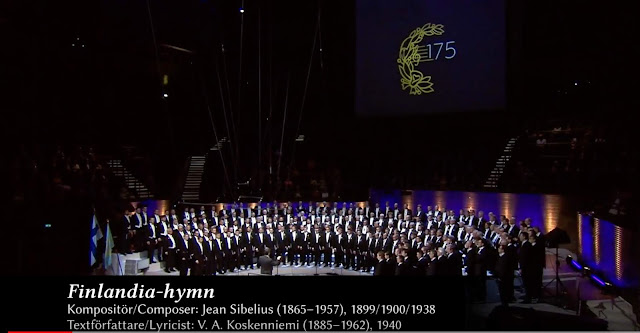
Growing up in Finland in the middle of last century, every child understood the sacrifices that our armies had made to leave us a free, independent homeland. Much of the teaching came from patriotic music: songs that we knew by heart from first grade on. One such "musical teacher" was Jean Sibelius' tone poem Finlandia, or Suomi. Oh, the thrill and fervor even the youngest heart felt right from the first discordant measure of the majestic orchestral sound. And then, after the battle of the brass, as if echoing the sounds of war, a calm, reassuring harmony made way for the resolution of conflict that would end the long-lived oppression. This is why every Finn beams with patriotism when he hears this majestic music.


Originally, there was no text to the hymn section of Jean Sibelius' Finlandia; for 40 years Sibelius successfully resisted attempts of many to write such libretto. Finally, in 1940, Veikko  A. Koskenniemi’s creation was acceptable to Sibelius, and the nod was given to go ahead and officially include the poetry. The events in Finnish history lead to this text and its acceptance by the Maestro.

1940 was a seminal time in Finland’s history. On 30 November 1939, Russia invaded Finland, and thus commenced the infamous Winter War (three months after the outbreak of World War II). Finland fought courageously in the freezing winter weather, and the enemy was no match in the snowy fields of Finland. The conflict ended with the signing of the Moscow Peace Treaty on 13 March 1940.

At this noteworthy moment, the culmination of Finland’s strivings for complete independence, Sibelius and Koskenniemi combined their artistic strength resulting in the declaration of victory, “Thy morning has commenced, Oh, Fatherland!”

It may also be important to note the original occasion for which Sibelius composed his tone poem Finlandia—the Press Celebrations of 1899,  a covert protest against increasing censorship from the Russian Empire. The symphonic tone poem was the last of seven pieces performed as accompaniment to tableaux depicting episodes from Finnish history. Sibelius’ composition caused passionate patriotism to the point of raising riots, which lead Russia to ban its subsequent perfomances. However, Finlandia was included in concert programs under various alias titles.

Most of the tone poem is taken up with rousing and turbulent music, evoking the national struggle of the Finnish people. Towards the end, a calm comes over the orchestra, and the serenly melodic Hymn is heard. It still arouses strong patriotic feelings in Finnish hearts.

I hope the reader will understand why it is hard for me to hear the hymn section set to foreign words, and why this is the only way this beautiful hymn ought to be heard:


Sunday, August 7, 2016

BRIDGES OVER PIELISJOKI


It all looks so small now, viewed from the distance of several decades, but a large portion of my life’s experiences revolved around that small island, water and bridges.

|||||


It seems that bridges played a substantial role in my childhood and youth. During those precious years in my life in Joensuu, there were three bridges, Itäsilta (East Bridge), Länsisilta (West Bridge) and Kanavansilta (Channel Bridge.)  Nowadays—at least six, maybe more. In the picture above, the bridge on the left is the Itäsilta, and the other visible one is, of course, the Länsisilta. Kanavansilta, the drawbridge, is located just at the right edge of the photo.


Itäsilta—East Bridge

Länsisilta—West Bridge

Kanavansilta—Drawbridge

My home was in a nearby suburb (first Peltola and then Kettuvaara), about two kilometers from the town center, separated by those three bridges. I crossed them every day either on foot or by bike—to school, church, shopping, library, movies, sports (mainly swimming and ice-skating, according to the season), summer jobs, friends' houses, etc. One of my favorite stops that I made on my way home from school was to see my dad in the venerable old government building, Pielislinna, pictured below, where he worked, employed by the Finnish Army.  I have sweet memories of meeting him there and playing telephone tag with him; he would tap the phone in another office and I would answer. Now, that was really fun for me as a youngster, for we did not have a phone at home.


Pielislinna

I now realize more fully how important that island—called Ilosaari (Happy Island)—was in my growing up years. I learned to swim and dive in the lagoon. Summer theater was always a highlight. That large red-roofed building (referring back to the first photo) was a multipurpose conference center called Karjalantalo (Karelia House) where our church meetings were held for a while. Later on, I worked as a guide at the Pohjois-Karjalan Maakunta Museo (North Karelia County Museum) located at the lower level of that building, as well. In addition, many functions took place there, such as dances and other occasions.

I remember singing there, in a trio with two other girls, as part of the entertainment at a military induction celebration. Yeah, I did that. Finnish folk songs. That I had arranged for three voices, performed a cappella.

Karjalantalo—Karelia House


Uimakoulu—Swimming School


Above, a photo that shows two of the bridges. It also shows the roof (red) of my old school, which later on also housed the city library and an art museum. I worked in the museum as a guide during two summers. This edifice, Joensuun tyttölyseo, is a beautiful landmark and still serves as a splendid example of Jugend architecture (Art Nouveau in America). So many memories, some good, some not so good...

And speaking of school, one high-spirited moment was witnessed by passers-by on one of those bridges after the last examination in high school (ylioppilaskirjoitukset, or "matriculation examination"). On my way home with friends, I threw all my school text books, one by one, down into the river from Itäsilta...  "No more pencils, no more books, no more teachers' dirty looks." And that's the wildest thing I ever did. (If you believe that, you might be of easier credulity than I thought!)

But that's not all where I encountered bridges. Perhaps someone who interprets dreams can tell me why I had persistent nightmares about those bridges. In the dreams, I was always afraid I would fall off and plunge into the rapids that raged underneath. The surface of the West Bridge was made with wooden planks with tiny cracks in between them for draining rain and melting snow, and my fear in the dreams was always that I would fall in between the planks. Come to think of it, I was afraid of that even in real life! Or that the bridge would meander and swerve and I would never get home. Those were real night terrors. So why did I dream such scary things? What do they mean? Have some of the secrets in them come true? Do I even believe in dreams?

I have no answers.


Wednesday, July 27, 2016

JAPANESE TEA BOXES


We've seen some pretty tea pots and tea cups—pretty enough to collect and keep on display in prominently located curio cabinets or shelves—and now we can add to them tea boxes (or chabako) from Japan. These are truly authentically Japanese, covered with authentic Japanese obi or other exquisite fabrics—authentic, of course! 

So, what are these Japanese tea boxes? They are thin-walled wooden boxes of vastly varying sizes—from 1-kg size up to 60 kg—lined with sheets of tin to keep tea dry and fresh. With the arrival of Tupperware some decades ago, however, these wooden boxes are hardly ever used in today's Japanese households. They have become more a nostalgic item that these days seems to connect East with West in that it is the Westerner who is interested in this nostalgia. Many women are keen to learn how to cover them, to "upholster" them, thus making them into decorative items, from small boxes to keep on shelves or tables to foot stools or side tables. They also make excellent moving boxes. (Not as cheap as cardboard, but all included in the move, so why not?)


The flat boxes are nori boxes. (Nori is a seaweed.)

I became interested in—or more precisely, fascinated by if not obsessed with—these boxes when we lived in Tokyo. I realized that by using old Japanese obi for covering them, this combination made a perfect marriage by which to remember Japan. There was a store called "Chicago" where they sold funky second-hand clothing and used obis and kimonos. The store was located in Omotesando; our driver Wataraisan would take me there regularly. Aaah, what sweet memories! 

Below are some examples of the ones, in various sizes, that I have upholstered. Most were given away as gifts—a very welcome gift to an expat living in Japan or Japanese friends.

The top left box is covered with a piece from an old Indian sari; the others are from obi.


This one may be my favorite, due to the simplicity of embroidery on the obi and the decorative studs that I embedded on the front.

Here is an example of one the larger ones I saw, a beautifully upholstered piece that makes an attractive trunk or a coffee table. It sits on a stand that was made specifically for arrangements like this... handmade, impressive.


Photo from chabakointernational.com


So, these photos and stories ought to waken some curiosity about the Japanese obi. If so, here are just a few photos of them:


And with that, I feel another post coming on about these gorgeous things...

|||||

Photo from chabakointernational.com

|||||


Thursday, July 21, 2016

DIVORCE, AMERICAN STYLE


|||

Dear American liberals, leftists, social progressives, socialists, Marxists and Obama supporters, et al: 

We have stuck together since the late 1950s for the sake of the kids, but the whole of this latest election process has made me realize that I want a divorce.

I know we tolerated each other for many years for the sake of future generations, but sadly, this relationship has clearly run its course.

Our two ideological sides of America cannot and will not ever agree on what is right for us all, so let's just end it on friendly terms.

We can smile and chalk it up to irreconcilable differences and go our own way. 

Here is our separation agreement:

 Our two groups can equitably divide up the country by landmass each taking a similar portion. That will be the difficult part, but I am sure our two sides can come to a friendly agreement.

After that, it should be relatively easy! Our respective representatives can effortlessly divide other assets since both sides have such distinct and disparate tastes.

 We don't like to redistribute taxes, so you can keep them.

 You are welcome to the liberal judges and the ACLU.

 Since you hate guns and war, we'll take our firearms, the cops, the NRA and the military. 

 We'll take the nasty, smelly oil industry and the coal mines, and you can go with wind, solar and biodiesel.

 You can keep Oprah, Michael Moore and Rosie O'Donnell. You are, however, responsible for finding a bio-diesel vehicle big enough to move them. 

 We'll keep capitalism, greedy corporations, pharmaceutical companies, Wal-Mart and Wall Street (and Hobby Lobby for their Christian values).

 We'll keep Bill O'Reilly and the Bible, and give you NBC and Hollywood.

 You can make nice with Iran and Palestine and we'll retain the right to invade and hammer places that threaten us.

 You can have the peaceniks and war protesters. When our allies or our way of life are under assault, we'll help provide them security.

 We'll keep our Judeo-Christian values.

 You are welcome to Islam, Scientology, Humanism, political correctness and Shirley McClain. You can also have the U.N. but we will no longer be paying the bill.

 We'll keep the SUVs, pickup trucks and oversized luxury cars. You can take every Volt and Leaf you can find.

 You can give everyone healthcare if you can find any practicing doctors.

 We'll keep "The Battle Hymn of the Republic" and "The National Anthem."

 I'm sure you'll be happy to substitute "Imagine," "I'd Like to Teach the World to Sing," "Kum Ba Ya" or "We Are the World."

 We'll practice trickle-down economics and you can continue to give trickle up poverty your best shot.

 Since they often offend you, we'll keep our history, our name and our flag.

And, in the spirit of friendly parting, I'll bet you might think about which one of us will need whose help in 15 years.


Sincerely, 

John J. Wall

Law Student and an American

|||


|||


Thursday, July 14, 2016

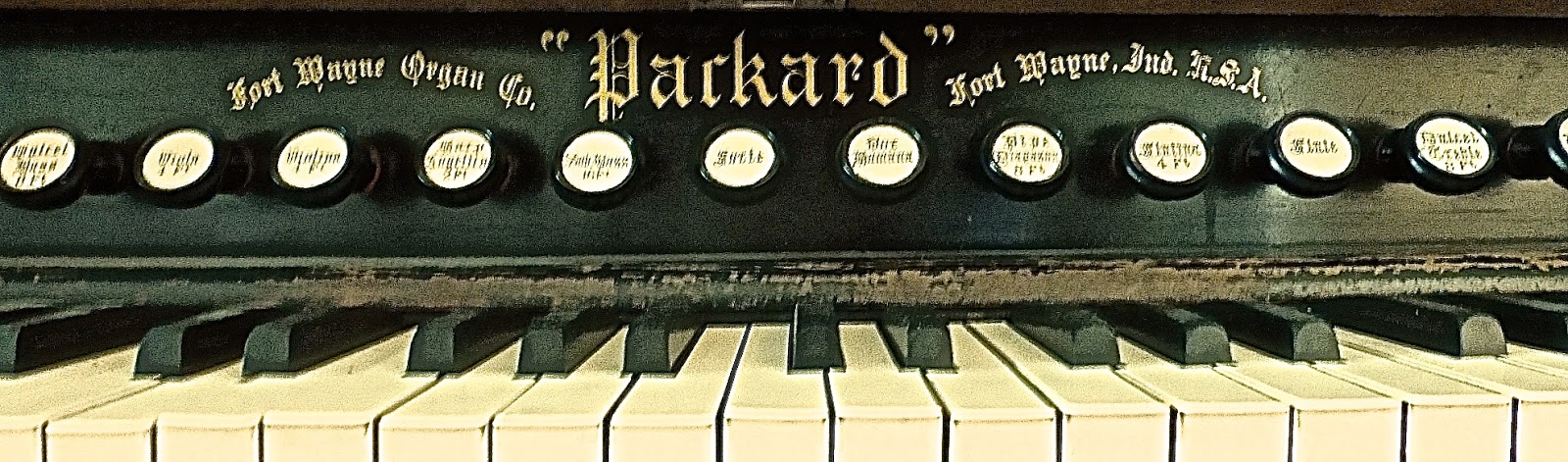
OLD PACKARD ORGAN


|||||


Two years ago we purchased a beautiful pump organ which was to fill the void I felt after we sold our grand piano. I never thought we’d ever part with that piano, but at that time we were serious about selling our 'Taco Bell' house (as some have called it...) and moving westward to be closer to our children. We did not want to ship the large instrument that had already been around the world a couple times (purchased in New Hampshire, from there to Boston to Schenectady NY to Hong Kong to Saudi Arabia to Dubai to Tokyo to Utah to North Carolina in one house and then to this present one). But as fate would have it, we stayed in North Carolina. And the emptiness without an instrument like our Kawai grand was almost more than I could bear. So, several years after the exodus of the piano, my husband bought this glorious instrument—that does not make a sound, yet.


This beauty is over 100 years old and can still evoke admiration and nostalgia. It has been on a wild adventure. Built by The Fort Wayne Organ Company, in Chicago, most likely during the transition of the company from the Fort Wayne Organ Company to The Packard Company, which would put the date somewhere around the turn of the century, i.e., 1900. The organ was purchased by a Presbyterian church in Aberdeen, Scotland, and graced the small church there until the 1970s when the church was remodeled. At that time, the organ was purchased by Americans who moved it to Belgium. In 1984 it changed hands again and became the property of an American expatriot family, still in Belgium. The travels continued to Summit, New Jersey, and then into storage in Salt Lake City for several years, and finally, to Pinehurst, where we purchased it. The ‘expariot’ organ has finally found its permanent home!

I collected some cursory information of the The Packard Organ Company and its history.


Packard Organ and salesmen in 1890s

Organs 1898-1914

“This time period marks the beginning of the end of organ production by the Packard Company. In 1899, the company name had changed from The Fort Wayne Organ Company to The Packard Company. Also, the emphasis began to be placed on piano production, and the company was focused on the piano part of the business.

“Organ production ceased by the end of 1914, and the company name was changed from The Packard Company to The Packard Piano Company, ushering in a new year and a new era in 1915.”

I can’t believe the disrespect we demonstrated by keeping this treasure in our garage for two years! Well seasoned now, I surmise!


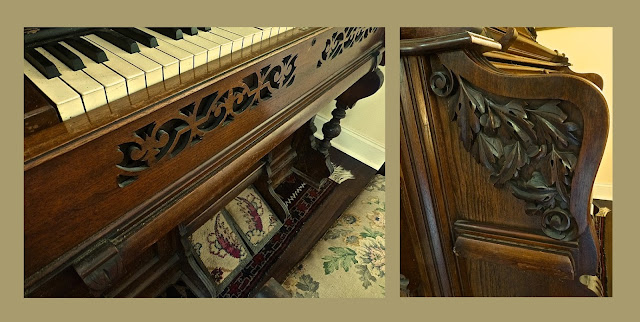
Looking at other Packard organs, it is easy to see that ours is missing some decorative elements, namely the upper corners of the cabinet. The straight lines were a dead give-away that something was missing, and now we know what it might have been. There are only two screw holes on the two ends, which suggets that there was a decorative piece that went all the way across the top of the case.


The keys are in excellent condition for such an old keyboard, with no cracks and minimal yellowing, all good features. The cabinet has a few problem spots— nothing that some TLC could not fix. The biggest problem is that the bellows are not operable by the pedals, so that has to be fixed by an expert. So, so far, it is a "dumb organ"...


The drawers of the console are like time capsules, telling of times gone by and individuals who were real, singing, playing and studying the Scriptures. What a rich heritage just in a few pictures!

Many musical scores were found, these handwritten, possibly original compositions:


Daniel was a Praying Man; Lord, Send Me; Be Not Afraid
Stops to be used 

Old Testament study outline; Biblical map

Enrollment, activity and attendance notes


Some notable details:


So here she is, still on the rug that was used to facilitate the move inside:


|||||


|||||


I have fond memories of playing a pump organ as I was getting into music. We did not have one; a friend's father was the principal of a small school where they had such an organ, and I was permitted to play it to my heart's content!

You can hear a Packard pump organ being played here:
(Clearly, we did not buy it for the sound...)


|||||