Thursday, July 21, 2016

DIVORCE, AMERICAN STYLE


|||

Dear American liberals, leftists, social progressives, socialists, Marxists and Obama supporters, et al: 

We have stuck together since the late 1950s for the sake of the kids, but the whole of this latest election process has made me realize that I want a divorce.

I know we tolerated each other for many years for the sake of future generations, but sadly, this relationship has clearly run its course.

Our two ideological sides of America cannot and will not ever agree on what is right for us all, so let's just end it on friendly terms.

We can smile and chalk it up to irreconcilable differences and go our own way. 

Here is our separation agreement:

 Our two groups can equitably divide up the country by landmass each taking a similar portion. That will be the difficult part, but I am sure our two sides can come to a friendly agreement.

After that, it should be relatively easy! Our respective representatives can effortlessly divide other assets since both sides have such distinct and disparate tastes.

 We don't like to redistribute taxes, so you can keep them.

 You are welcome to the liberal judges and the ACLU.

 Since you hate guns and war, we'll take our firearms, the cops, the NRA and the military. 

 We'll take the nasty, smelly oil industry and the coal mines, and you can go with wind, solar and biodiesel.

 You can keep Oprah, Michael Moore and Rosie O'Donnell. You are, however, responsible for finding a bio-diesel vehicle big enough to move them. 

 We'll keep capitalism, greedy corporations, pharmaceutical companies, Wal-Mart and Wall Street (and Hobby Lobby for their Christian values).

 We'll keep Bill O'Reilly and the Bible, and give you NBC and Hollywood.

 You can make nice with Iran and Palestine and we'll retain the right to invade and hammer places that threaten us.

 You can have the peaceniks and war protesters. When our allies or our way of life are under assault, we'll help provide them security.

 We'll keep our Judeo-Christian values.

 You are welcome to Islam, Scientology, Humanism, political correctness and Shirley McClain. You can also have the U.N. but we will no longer be paying the bill.

 We'll keep the SUVs, pickup trucks and oversized luxury cars. You can take every Volt and Leaf you can find.

 You can give everyone healthcare if you can find any practicing doctors.

 We'll keep "The Battle Hymn of the Republic" and "The National Anthem."

 I'm sure you'll be happy to substitute "Imagine," "I'd Like to Teach the World to Sing," "Kum Ba Ya" or "We Are the World."

 We'll practice trickle-down economics and you can continue to give trickle up poverty your best shot.

 Since they often offend you, we'll keep our history, our name and our flag.

And, in the spirit of friendly parting, I'll bet you might think about which one of us will need whose help in 15 years.


Sincerely, 

John J. Wall

Law Student and an American

|||


|||


Thursday, July 14, 2016

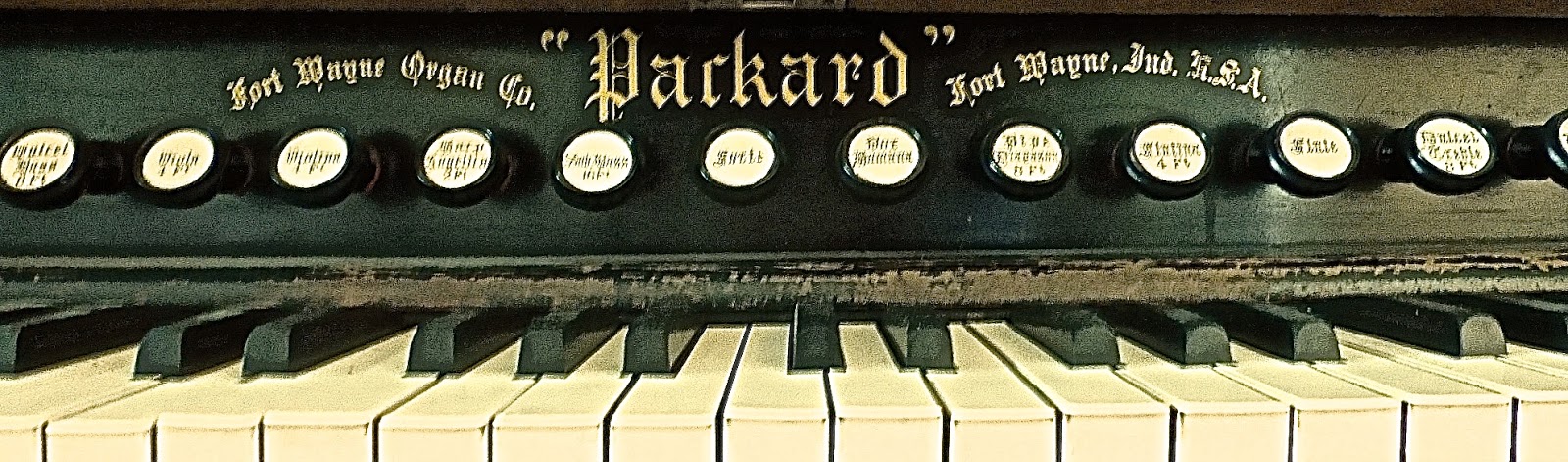
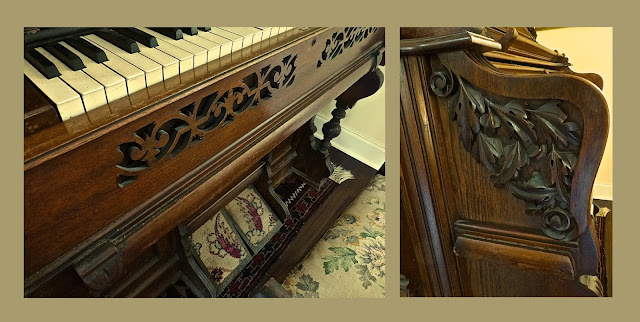
OLD PACKARD ORGAN


|||||


Two years ago we purchased a beautiful pump organ which was to fill the void I felt after we sold our grand piano. I never thought we’d ever part with that piano, but at that time we were serious about selling our 'Taco Bell' house (as some have called it...) and moving westward to be closer to our children. We did not want to ship the large instrument that had already been around the world a couple times (purchased in New Hampshire, from there to Boston to Schenectady NY to Hong Kong to Saudi Arabia to Dubai to Tokyo to Utah to North Carolina in one house and then to this present one). But as fate would have it, we stayed in North Carolina. And the emptiness without an instrument like our Kawai grand was almost more than I could bear. So, several years after the exodus of the piano, my husband bought this glorious instrument—that does not make a sound, yet.


This beauty is over 100 years old and can still evoke admiration and nostalgia. It has been on a wild adventure. Built by The Fort Wayne Organ Company, in Chicago, most likely during the transition of the company from the Fort Wayne Organ Company to The Packard Company, which would put the date somewhere around the turn of the century, i.e., 1900. The organ was purchased by a Presbyterian church in Aberdeen, Scotland, and graced the small church there until the 1970s when the church was remodeled. At that time, the organ was purchased by Americans who moved it to Belgium. In 1984 it changed hands again and became the property of an American expatriot family, still in Belgium. The travels continued to Summit, New Jersey, and then into storage in Salt Lake City for several years, and finally, to Pinehurst, where we purchased it. The ‘expariot’ organ has finally found its permanent home!

I collected some cursory information of the The Packard Organ Company and its history.


Packard Organ and salesmen in 1890s

Organs 1898-1914

“This time period marks the beginning of the end of organ production by the Packard Company. In 1899, the company name had changed from The Fort Wayne Organ Company to The Packard Company. Also, the emphasis began to be placed on piano production, and the company was focused on the piano part of the business.

“Organ production ceased by the end of 1914, and the company name was changed from The Packard Company to The Packard Piano Company, ushering in a new year and a new era in 1915.”

I can’t believe the disrespect we demonstrated by keeping this treasure in our garage for two years! Well seasoned now, I surmise!


Looking at other Packard organs, it is easy to see that ours is missing some decorative elements, namely the upper corners of the cabinet. The straight lines were a dead give-away that something was missing, and now we know what it might have been. There are only two screw holes on the two ends, which suggets that there was a decorative piece that went all the way across the top of the case.


The keys are in excellent condition for such an old keyboard, with no cracks and minimal yellowing, all good features. The cabinet has a few problem spots— nothing that some TLC could not fix. The biggest problem is that the bellows are not operable by the pedals, so that has to be fixed by an expert. So, so far, it is a "dumb organ"...


The drawers of the console are like time capsules, telling of times gone by and individuals who were real, singing, playing and studying the Scriptures. What a rich heritage just in a few pictures!

Many musical scores were found, these handwritten, possibly original compositions:


Daniel was a Praying Man; Lord, Send Me; Be Not Afraid
Stops to be used 

Old Testament study outline; Biblical map

Enrollment, activity and attendance notes


Some notable details:


So here she is, still on the rug that was used to facilitate the move inside:


|||||


|||||


I have fond memories of playing a pump organ as I was getting into music. We did not have one; a friend's father was the principal of a small school where they had such an organ, and I was permitted to play it to my heart's content!

You can hear a Packard pump organ being played here:
(Clearly, we did not buy it for the sound...)


|||||

Thursday, June 16, 2016

Living Water


Giovanni Francesco Barbieri, Jesus and the Woman of Samaria

“Jesus answered and said unto her, Whosoever drinketh of this water shall thirst again: But whosoever drinketh of the water that I shall give him shall never thirst; but the water that I shall give him shall be in him a well of water springing up into everlasting life.”


This painting by Giovanni Francesco Barbieri, Jesus and the Woman of Samaria, is one that has me totally mesmerised.  Of all the depictions of Christ that I have seen, none has spoken so deeply and profoundly to my soul as this one. I am captured by his teaching attitude, his obvious concern of the woman—his right hand moving and his head turned as if to reach her more surely as he explains that he can give her “living water” and that she would never thirst again if she partook. 

The woman seems relaxed and comfortable with Jesus. Her posture and demeaner speak of interest but at the same time, of incredulity: “How can he offer me water that will take away my thirst for good?” But she wants to know more.

There is certain ease, combined with movement and fluid gestures in both of their hands and arms, that conveys a genuine, sincere experience on both sides.

All that said, there remains something  unexplainable about the artist’s depiction of the scene—more inexplicably of the Savior—that has affected me accutely.


The Artist

Giovanni Francesco Barbieri, self-portrait 
Giovanni Francesco Barbieri (February 8, 1591–December 22, 1666), best known as Il Guercino, was an Italian Baroque painter and draftsman from the region of Emilia, and active in Rome and Bologna. The vigorous naturalism of his early manner is in contrast to the classical equilibrium of his later works. His many drawings are noted for their luminosity and lively style.

At an early age he acquired the nickname Guercino (Italian for 'squinter') because he was cross-eyed. Mainly self-taught, at the age of 16, he worked as apprentice in the shop of Benedetto Gennari, a painter of the Bologneses School.

Guercino was remarkable for the extreme rapidity of his executions: he completed no fewer than 106 large altarpieces for churches, and his other paintings amount to about 144. He was also a prolific draftsman. His production includes many drawings, usually in ink, washed ink, or red chalk. Most of them were made as preparatory studies for his paintings, but he also drew landscapes, genre subjects, and caricatures for his own enjoyment. Guercino's drawings are known for their fluent style in which "rapid, calligraphic pen strokes combined with dots, dashes, and parallel hatching lines describe the forms." Guercino continued to paint and teach until his death in 1666, amassing a notable fortune. (From Wikipedia)


The Background

John 4: 5-15
5 Then cometh he to a city of Samaria, which is called Sychar, near to the parcel of ground that Jacob gave to his son Joseph.
6 Now Jacob’s well was there. Jesus therefore, being wearied with his journey, sat thus on the well: and it was about the sixth hour. 
7 There cometh a woman of Samaria to draw water: Jesus saith unto her, Give me to drink. 
8 (For his disciples were gone away unto the city to buy meat.) 
9 Then saith the woman of Samaria unto him, How is it that thou, being a Jew, askest drink of me, which am a woman of Samaria? for the Jews have no dealings with the Samaritans . 
10 Jesus answered and said unto her, If thou knewest the gift of God, and who it is that saith to thee, Give me to drink; thou wouldest have asked of him, and he would have given thee living water. 
11 The woman saith unto him, Sir, thou hast nothing to draw with, and the well is deep: from whence then hast thou that living water? 
12 Art thou greater than our father Jacob, which gave us the well, and drank thereof himself, and his children, and his cattle? 
13 Jesus answered and said unto her, Whosoever drinketh of this water shall thirst again: 
14 But whosoever drinketh of the water that I shall give him shall never thirst ; but the water that I shall give him shall be in him a well of water springing up into everlasting life. 
15 The woman saith unto him, Sir, give me this water, that I thirst not, neither come hither to draw.


Other Works

Personification of Astrology (1650) 

I have for long been interested in and fascinated by the armillary. I wanted one large one in my garden, but it was not to be... So I admire them wherever I see them. This may be one of the reasons why this “Astrologia” painting spoke to me.

Nothing is known about the model displaying the armillary here. But I did dig up some more detailed information that I did not know about the instrument she is holding.

Armillary spheres can be divided into two main categories: the observational armillary as used by Ptoemy and Tycho Brahe, and the demonstrational instrument. Both types consist of a number of rings (Latin, armillae) which are arranged so as to model the circles of the celestial sphere. Typically, armillary spheres used for observation were larger and possessed fewer rings than those which served as demonstrational instruments; this made them more accurate and easier to use. Often the rings of demonstrational armillaries, like those of the observational spheres, were divided, and some incorporated sights which could be used to orient the instrument appropriately.

The armillary sphere described by Ptolemy was a zodiacal instrument of six rings, designed to determine the locations of celestial objects according to the ecliptic co-ordinate system. The sphere was first set to the appropriate latitude by ensuring that its outer fixed meridian ring was perpendicular to the horizon, and parallel to the actual meridian—in other words aligned along a North-South line. The orientation of the instrument was establishing by sighting on a celestial object (the sun or a star) whose position in the ecliptic—that is, its celestial longitude—was known. Two rings, one a divided ecliptic ring, and one corresponding to the latitude component, were used for this task. An inner latitude ring was also divided; nesting within it was another ring to which diametrically opposed sights had been fitted, and which could turn within the latitude ring. By using these sights to observe a celestial body, the position of the body could be determined in ecliptic co-ordinates by reading off the longitude from the divided ecliptic ring and the latitude from the position of the far sight north or south of the ecliptic on the divided latitude ring. (From Starry Messenger)

It just so happens I do have one small table-top armillary...


Notable works of Guercino's are numerous, as was pointed out, of which these two are typical—religious renditions of Christ's entombment:


Some other works of Guercino's include red chalk drawings, such as these:


||||

||||


Tuesday, June 14, 2016

Girls with Pearl Earrings


 LIFE IMITATES ART II
As I was surfing the Internet, I came across this famous painting of a Dutch girl by Johannes Vermeer. What caught my attention in particular—having already become acquainted with this painting—was another picture juxtaposed with it. My reaction was like,”Oh my, that’s just like my series from last year, ‘Life Imitates Art.’” True to my nature, I became totally engrossed in the idea of finding possible other similar depictions. To my delight, the research proved almost overwhelmingly fruitful.

Johannes Vermeer (1632-1675)
But first, let me say something about the author of the original. Johannes Vermeer (1632 – December 1675) was a Dutch artist who specialized in domestic interior scenes of middle-class life. Vermeer was a moderately successful provincial genre painter in his lifetime. He evidently was not wealthy, leaving his wife and children in debt at his death, perhaps because he produced relatively few paintings.

Vermeer worked slowly and with great care, and frequently used very expensive pigments. He is particularly renowned for his masterly treatment and use of light in his work.

Almost all his paintings are apparently set in two smallish rooms in his house in Delft; they show the same furniture and decorations in various arrangements and they often portray the same people, mostly women.

Perhaps the best-known of Vermeer’s works is his Girl with a Pearl Earring (Meisje met de parel). It is an oil painting of a girl with a head scarf and a pearl earring. It depicts a Dutch girl wearing an exotic dress, an oriental turban, and an improbably large pearl earring.The estimated date of the painting is around 1665. Its size is rather small, 17” high and 15.5” wide.

In 2014, Dutch astrophysicist Vincent Icke raised doubts about the material of the earring and argued that it looks more like polished tin than pearl on the grounds of the specular reflection, the pear shape and the large size of the earring.

After the most recent restoration of the painting in 1994, the subtle color scheme and the intimacy of the girl's gaze toward the viewer have been greatly enhanced. During the restoration, it was discovered that the dark background, today somewhat mottled, was initially intended by the painter to be a deep enamel-like green. This effect was produced by applying a thin transparent layer of paint, called a glaze, over the present-day black background. However, the two organic pigments of the green glaze, indigo and weld have faded. (Source: Wikipedia)


I had no idea how much the painting has inspired other depictions, either merely imitating, or spoofing the master. Some are in the “true” vein of “Life Imitates Art” with photographs of  live models; others are imitation paintings or satiric renditions.

I was not so much interested in the source of the depictions as their varieties. These are just a few of the ones I liked. I call the collection "Girls with Pearl Earrings."


Other types of imitations are also kind of fun and interesting, though some spoofs in my opinion have crossed over to the side of irreverance towards great art;  they will remain unexplored in this write-up. But I will include these cute dolls that were inspired by Vermeer's art.


And to finish up, this is the best of them all:


||||

||||