Monday, December 7, 2015

I Remember Christmas

I remember those Christmases as if yesterday. They came with deep meaning, earnest preparation and overflowing anticipation.

*****
 In the cold and dreary North, Christmas comes as a festival of light with candles and sparklers, and a show of love and generosity. The embodiment of light to me, as a child, was the tall, snow-covered pine tree all lit up with electric lights in the park in the middle of town. It must have been a hundred feet tall, reaching all the way to Heaven! There was a special lighting ceremony, and most of the town gathered around. As the lights were switched on, all exclaimed in unison with approval and admiration. The winter night waxed cold and all seemed to do a strange dance, stomping to keep their feet warm. But somehow the feet didn’t really matter, because our hearts were warm.

  Part of the unexplainable magic came in store windows. Shopping in those days was simple and unassuming. Not much money exchanged hands—the stores seemed to decorate their windows for more show than enticement to buy. One certain shop was famous for mechanized displays—Santa in his workshop with his little helpers, or a beautiful winter scene on a frozen lake with ice-skaters and music. How did they do that Magic? My eyes were glued to the delicately moving figures until I was part of the scene. To own it? Never entered my heart.

A couple of the main streets in town hung decorations on the lamp-posts. Some extended across the street, swaged from building to building. Christmas music was played over loudspeakers. A week before Christmas joulupukki himself came to town in his sleigh, throwing candy to eager little spectators. Christmas had arrived!

Mother signaled the start of the festive season in our home by gathering her secret ingredients for her aromatic gingerbread cookies, tarts and special breads. There were the old familiar well-worn baking board, heaping with sacks of flour and sugar, small canisters of fragrant cinnamon, ginger and nutmeg, a ceramic bowl that donned cracks and nicks from diligent use, a bent wooden mixing spoon, a handmade, one-piece rolling pin, and three shapes of aluminum cookie cutters: a star, a crescent moon and the traditional scalloped ginger snap cutter. In a matter of minutes it seemed, Mother created the most heavenly array of Christmas goodies, and the entire house was filled with the true fragrance of Christmas.

In school, we started making our little presents for our families well in advance. As a young child, each Christmas I crocheted hot pads for Mother, a scarf for Father and mittens for my brother. Often it was hard to tell the hot pads from the mittens, but it made no difference to us—they were all made with simple love. I usually received a refurbished doll: either the doll had a new, pretty head, or her clothes were spanking new. My brother’s usual present was a new hockey stick and pucks—the icy lakes were ideal for ice-hockey for several months.

The week before Christmas was the season for many pikkujoulus, "Little Christmases," parties where the Christmas spirit—and all Christmas creatures—came out. The creatures were, of course, tontut, our special kind of joulupukki's helpers, those jolly little elves dressed in blue and red. In fact, everyone at the party often dressed as tontut, and danced special little dances, singing “Soihdut sammuu, kaikki väki nukkuu, väki nukkuu . . .” Everyone received a little present from joulupukki, who was always kind enough to take time out of his busy Christmas schedule to come and visit and join in the singing and dancing.

  But those little tontut had a much more serious role to carry out than singing and dancing at pikkujoulu. They would keep an eye on us children, sneaking around the house or peaking through the windows to see how we were behaving. What an opportune time for parents to instill nice manners in their little folk, for we sure were careful to observe all the rules and wishes presented to us. After all, we were not going to be naughty, for naughty children only got a bundle of twigs at Christmas, and no presents at all.

  The tree was not cut or bought until the morning of Christmas Eve. Father usually went to the marketplace in the middle of our town and selected the one he deemed suitable for our family and house. It was always a beautiful, straight and symmetrical blue spruce, with lots of sturdy branches for placing the real little candles.

Decorating the tree was usually my task. What an important responsibility that was! To get the candles to stand up straight, carefully placed so that the flames would not touch the branches above… To spread the garland in perfect patterns, the sparklers and the colorfully wrapped wooden candy crackers in appropriate places… But most importantly—and this was always done under Father’s supervision—to crown the tree with the Star of Bethlehem!

  The tree was dressed in the afternoon of Christmas Eve. Now it was time for Mother to put the fatty Christmas ham in the oven. She had prepared it with a pasty coating made of rye flour, salt and water—it made the shank of ham juicy and full of flavor. In our home, Mother had to heat the oven first by burning wood inside the oven, and when it was appropriately hot—I never knew exactly how she determined that—she would sweep the hot embers out of the oven and place them in the stove where they would heat some other Christmas delicacy ready for cooking.

While the ham was thus baking, we took turns going for the traditional Christmas sauna. There were fluffy towels scattered around, with a new crop of fragrant dried birch branches for our vasta. The sauna seemed unusually dimly lit for this special occasion—only a few candles burned in the small window to accentuate the festive feeling. Usually Mother and I would go first so that we could be preparing the Christmas meal details as the men folk enjoyed their sauna.

The meal was spread for the spanking clean sauna-goers: piping hot ham in its brown crust, casseroles of carrots and rutabaga, boiled potatoes and a beverage of home-brewed Christmas beer we called kalja. For dessert there were rice pudding and plum kiisseli—a sort of thickened soup that went well with the pudding. And the never-ending variety of Christmas gingerbread cookies, prune tarts and sweet breads.

The table was decorated with bowls of sweet-smelling fruit—a rare commodity for the Northerners in the dead of winter—great big oranges from Jaffa, and apples and pears. In the center of the table was a potted flower, a cluster of tulips, hyacinths, freesias or crocuses—a fragrant promise of spring yet so far away. Surely there was no better time in the entire year!

  About dessert time there usually came a knock at the door, and we all knew who it was: joulupukki, of course! This old man came dressed in a drab fur coat, with long hair and beard, carrying a tattered old bag full of wonderful surprises. We always invited Him in with certain reverence and great excitement, and He always had time to sit around, enjoy the lively flames of the candles on the tree, an occasional sparkler and many a Christmas hymn sung by children whose hearts were bursting with the glory of the moment. And for some magical reason, even though this venerable old man seemed to bring me the same doll, with obvious variations, year after year, it did not matter. This was Christmas time, a time of Love, Light, Warmth and Magic, and there was no room for questions.


Friday, October 2, 2015

Jean Sibelius' Solo Songs


by Liisa Berg


“Meeting Sibelius is like being confronted by a power of nature. He looks like an old eagle in a storm, like a towering pine or an emperor hewn from granite.” (Ture Rangström)

Few composers have been so preoccupied with one medium of expression as Sibelius. His great achievements as a symphonist tend to overshadow his output in other genres. Even a superficial look at his activity in other idioms quickly reveals that he, in deed, was a man of the orchestra. It is most interesting that a composer with such "extra-ordinary powers of compression, . . . ability to evoke a mood by the most economical gesture, as well as highly developed sense of line" would not be able to transfer these qualities to smaller forms of musical expression. This is not, of course, to dispute that there are many masterpieces among his more unexplored forms as well; the truth, however, remains, that there is no even quality or development of style in them.

By the side of his larger-scale orchestral music, Sibelius' solo songs represent a far more important side of his creative activity than is generally known. He himself believed in their future and was never inclined to consider them as mere incidental piéces d’'occasion. Santeri Levas recalls his conversation with Sibelius in which the master stated that his song literature represented his "innermost self." Levas further writes:

"One evening Sibelius mentioned quite in passing that he had composed songs only during a very brief period of his life and that afterwards he had lost interest in this activity. But very soon he repented of this remark. Early the next morning—much earlier than he normally got up—my telephone rang and Sibelius again took up our conversation of the previous day. 'During the night I was annoyed about what I said about my songs,' he said and added that he did not at all wish to describe his songs as insignificant, but that he considered both his vocal and piano pieces up to standard."

Among the nearly 150 vocal pieces that Sibelius composed, there are, indeed, certain pearls in the art of song, and they deserve closer examination and familiarization on the part of the foreign audiences. But if his songs are to be examined and judged fairly, it is most important to clear our minds of all the preconceived definitions of the art songs as exemplified in the German Lied. The latter evolved from the indigenous Volkslied, while Sibelius arrived at a declamatory, simple style akin to that of Hugo Wolf, for example, a style that the old bards might have chosen. It is therefore advisable that no comparisons be drawn between the two.

Sibelius produced his song literature in a time span of about 27 years. Among the many opuses are examples of surprisingly flexible quality. They are curiously unequal: within on opus there are truly admirable compositions side by side with some that are markedly inferior. Some are not much different from each other. Later songs are not necessarily better nor essentially different from earlier ones. With the less important songs it is easy to be struck by a feeling that Sibelius wanted to rid the momentary inspiration as quickly as possible and to advance into more serious writing.

Even though it is fairly evident that in this medium, Sibelius did not achieve the heights of Robert Schumann or Franz Schubert, a number of critics agree that "many of [his songs] have the sensitivity and beauty of construction of the best of Hugo Wolf and Grieg." Layton is of the opinion that the best of Sibelius song literature equals the "quasi-symphonic epigrams of Wolf [and] the vivid characterization and intense and often heart-rendering humanity of Mussorgsky."

The strange masterpiece, Luonnotar, half song with orchestra, half symphonic poem with vocal oglibato, is evidence of highly original approach to the voice. Yet, Sibelius's most original side rarely emerges in the songs. When it does, it is in response to a natural imagery; thus it is that most of his best songs are essentially nature pieces, with the human element, when present, in the background. It is in these nature songs that his melodic lines are dressed in most boldness and individuality. Sibelius was not a lyricist. His true nature emerges in his somber, dark-timbered song.

Sibelius is very demanding of the voice in general. There are great varieties of dynamics in short passages, and wide ranges are required in many of this songs. Skips over an octave are not unusual. An example of this appears in Luonnotar, in which there is a skip from an A'' to a D#' within one word. On the other hand, there are a good number of songs which encompass a modest vocal range. Many of these are among Joululauluja ("Christmas Carols," Opus 1), most of which have become solidly traditional in Finnish Christmas celebrations. Others have been written for a specific artist, as in the case of Opus 88. It was written for Ida Ekman, whose voice at that time (1916) was rather restricted in compass. Levas reports that Sibelius produced many of his best songs for Ida, who was always suggesting that he should do something new. For his part, he inspired Ida to her highest endeavors: she recounts that "when Sibelius was in the audience, [I] sang as if upheld by a magical influence." Incidents involving Ida Ekman reveal some of Sibelius's song-writer temperament: "Ida always received his songs at the last moment, although he had promised them . . . months beforehand. For example, the program had already been printed for a long time when she got her first sight of the first three songs of Op. 26, Svarta Rosor ("Black Roses"), Men min fågel märks dock icke ("But My Bird Is Long in Homing"), and Bollspelet vid Trianon ("Tennis at Trianon"). One of his most beautiful songs, På verandan vid havet ("On a Balcony by a Sea," Opus 38), was brought, by Sibelius himself, all out of breath, to the railway station when Ida Ekman, waiting for him with a pulsing heart as she counted the minutes, was out to start a recital tour."

Shortly before her death Ida wrote a letter to Sibelius describing her visit with a great master of that time, Johannes Brahms, in Vienna, at the house of Eduard Hanslick, a music critic. She had sung one of Sibelius's songs for him, S'en har jag ej frågat mera ("For I Have Asked No More," Op. 17, No. 1). "This pleased Brahms so much that he wanted to hear it again, and he took Hanslick’'s place at the piano." When they had finished, Brahms kissed the young singer on the forehead and said: "When we next meet you must sing more Sibelius than Brahms." Brahms was very enthusiastic about Sibelius' song and hurried to tell about it to his friends. Incidentally, Brahms did not very easily show approval of the works of his contemporaries; only when he came across true talent would he express admiration.

The Linguistic Problem
Sibelius' songs are second only in importance to his orchestral works, yet, for a reason they have been largely neglected by singers. They rarely appear in recital programs and there are no comprehensive recordings extant. Other masters encounter the same inequity: Mussorgsky, for example, is only on an occasion chosen for programs, due to the existing vast linguistic barrier. The inaccessibility of the Scandinavian languages (of which, incidentally, Finnish is completely, and very importantly, separate) to non-native singers has cut off the rest of the world from some of Sibelius’' finest works. Even when translated, audiences intuitively sense the disparity in the poor representation of the original texts. As in all translated libretti, the original inflexes and meanings are altered, often producing awkward and unnatural rises and falls, to which the original text usually attends beautifully.

Poetry
It was Sibelius' contention that if a piece of poetry was complete in itself, it had no need of musical setting. Thus he sought out texts that to his point of view would be elevated through music. The ideas within a poem appeared to Sibelius as a fairly subordinate issue. What was important was the overall atmosphere: "Music illuminates and intensifies the mood and feeling of the poetry without duplicating its verbal imagery," he believed. He further stated about his estimation of the relationship of poetry and the music he assigned to it: "My songs can also be sung without words. They are not so dependent on poetry as the songs of many other composers." In any case, his songs can only suffer when translated because of the inflections and intimations present in all languages.

Though the poetry of Sibelius' songs is mostly Swedish, the language of the vogue of his time—more than half are in Swedish—they are all inspired by his fatherland. Owing to Finland’'s former Swedish rule and culture, the native poets, such as Runeberg, Rydberg, Topelius and Tavastjerna, wrote chiefly in Swedish. Perhaps the fact that Sibelius himself spoke better Swedish than Finnish further encouraged him to choose Swedish texts for musical treatment. At the same time he was remarkably sensitive to the musical inflection of the Finnish language. He also used German, French, Italian, Latin and English texts—a fact that further illustrates his ecumenical approach to life as a whole. (He also spoke all of them fluently and studied the masterworks in their original languages, including Greek).

Above all, Sibelius was deeply inspired by the lyric nature poetry of J. L. Runeberg; some of Sibelius' finest songs are to the texts of Runeberg. In the order of frequency of usage, his poets—and other sources—rank in this manner: Runeberg (30), Tavastjerna, Rydberg, Josephson (10 each), Topelius (7), Fröding, Grippenberg (5 each) Kalevala (6) and Kanteletar (4). Others are Wechsell, Franzén, Kyösti, Cajander, Kurl, Dehmel, Shakespeare, Karlfeldt, Schybergon, Leino and Maesterlinck. As to the settings of the libretti, Sibelius is always at his best with the topic of nature. In settings of love lyrics, he is seldom completely successful, though an exception is found in Till Frigga. For the most part, in the field of the lovelorn, he lacks sensitivity, occasionally bordering "dangerously on the banal and the commonplace."

The most frequent topical use includes nature—seasons, night and day—jubilee hymns, humor, the joy of love, mourning, prayer and longing for death.

Accompaniment
One of the most limiting factors in Sibelius' song literature is his apparent uncertainty at the keyboard. Sibelius was not a pianist. "In my real work, the piano does not interest me; it cannot sing," he once explained. Fittingly, then, few of Sibelius’s piano pieces—which are many—reveal any love for the instrument. It is surprising, as Cecil Gray, a Sibelius biographer, points out, "that he should have written so much for an instrument which he does not seem to understand, and even appears positively to dislike and despise." It is not unexpected then that the piano parts in his songs appear relatively inferior. Rarely does his keyboard writing complement the vocal line with the freedom that can be found in Schumann and Wolf. In many instances, the piano merely doubles the voice, or else is somber chordal accompaniment—somewhat an orchestral approach. Naturally, there are exceptions. Opus 38 contains a specially exalting piano setting, of which Nils-Eric Ringbom writes: "A highly personal form of symbolistic composition is here combined with a strangely expressive vocal part. There is no empty decoration in the accompaniments, no external miniature painting. All is rarely powerful realism, painted in broad brushstrokes, which gives completely adequate musical expression to the poet's moods."

If man's relationship with nature is Sibelius' chief springboard for inspiration, it follows that the orchestra is the desirable and essential means of fulfillment. No wonder Sibelius's piano writing is shadowed by the orchestra. There is a clear illustration of this in the two versions of Höstkväll ("Autumn Evening"): the original for voice and piano and the later orchestral version. While the former is merely competent, the latter—half song, half operatic—is supremely successful. Rydberg’'s dealing with the solitary wanderer exulting in the power and majesty of Nature "struck a responsive chord in the composer. The atmosphere of the orchestral version . . . could hardly be more powerfully evoked."

From time to time, when someone wished to orchestrate some of his songs, Sibelius would give his consent, mostly due to his kindness. He did not want his songs to be tampered with; he regarded them as definite in form. Levas tells that Sibelius at the beginning of 1946 had forbidden the Finnish Broadcasting Company to perform his songs other then in their original form, with piano accompaniment. "I don't want them orchestrated," he said, "for they completely lose their individual character. One can't express little ideas by means of a large orchestra."

Perhaps it truly is this belief, freely applied, that was the guiding ideal for Sibelius as he worked on his fascinating solo song repertoire: a small idea needed its confined realm. Thus most of these "little ideas" stayed without the fullfilment that Sibelius generally achieved for his large-scale work. The generous gestures that identify his orchestral pieces are more modest in his solo songs, though certainly not without the Sibelian stamp that endows all his works with "rememerability" and realization of intent.


Sibelius at home: Ainola
Järvenpää


Sibelius' and his wife Aino's grave in the vicinity of their home in Järvenpää


Friday, September 4, 2015

I Will Not Burn the Book


I Will Not Burn the Book
BY DON VINCENZO DI FRANCESCA


Don Vincenzo di Francesca, a young priest from Italy, when he was visiting New York City in 1910, discovered a dirty, discarded book that was to change his life. This is his story in his own words as published in Liahona, June, 1988.
<<<<<([])>>>>>

As I think back to the events in my life leading to a cold morning in New York City in February1910, I am convinced that God had been mindful of my existence. That morning the caretaker of the Italian chapel delivered a note to me from the pastor. He was ill in bed and wished me to come to his house, as he had important matters to discuss regarding the affairs of the parish.

As I walked down a street near the harbor, the strong wind from the sea moved the pages of a book lying on a barrel full of ashes. The appearance of the pages and the binding made me think that it was a religious book. Curiosity pushed me to approach it. I picked it up and beat it against the barrel to knock off the ashes. It was printed in the English language, but when I looked to the title page, I found it was torn away.

The force of the wind turned the pages, and I hastily read Alma, Mosiah, Mormon, Moroni, Isaiah, Lamanites—except for Isaiah, all were names I had never before heard. I wrapped the book in a newspaper I had bought nearby and continued my walk toward the pastor’s house.

After a few words of comfort there, I decided what I should do for him. On the way home, I wondered who the people with the strange names might be. And who was this Isaiah? Was he the one in the Bible, or some other Isaiah?

At home, I seated myself before the window, anxious to know what was printed in the book. As I turned the torn pages and read the words of Isaiah, I was convinced that it was a religious book that talked of things to come. But I did not know the name of the church that taught such doctrine, because the cover and title page had been ripped off. The declaration of the witnesses gave me confidence that it was a true book.
I then bought some cleaning fluid and some cotton at the neighborhood drugstore and began cleaning the pages. For several hours I read the remainder of the pages, which gave me light and knowledge and made me wonder about the source from which this fresh revelation had come. I read and reread, twice and twice again, and I felt that the book was a fifth gospel of the Redeemer.

At the end of the day, I locked the door of my room, knelt with the book in my hands, and read chapter ten of the book of Moroni. I prayed to God, the Eternal Father, in the name of his son, Jesus Christ, to tell me if the book were of God, if it were good and true, and if I should use its words with the words of the four gospels in my preaching.

I felt my body become cold as the wind from the sea. Then my heart began to beat faster, and a feeling of gladness, as of finding something precious and extraordinary, comforted my soul and left me with a joy that human language cannot find words to describe. I had received the assurance that God had answered my prayer and that the book was of greatest benefit to me and to all who would listen to its words.

I continued my services in the parish, but my preaching was mixed with the new words of the book. The members of my congregation were so interested that they became dissatisfied with my colleagues’ sermons. When members began leaving the chapel during their sermons and remained when I occupied the pulpit, my colleagues became angry with me.

The beginning of real discord began Christmas Eve, 1910. In my sermon that evening, I told the story of the birth and mission of Jesus Christ as given in my new book. When I had finished, some of my colleagues publicly contradicted all I had said. They denounced me and turned me over to the Committee of Censure for disciplinary action.

When I appeared before this committee, the members gave what they supposed to be fatherly advice. They counseled me to burn the book, which they said was of the devil, since it had caused so much trouble and had destroyed the harmony of the pastoral brothers. I replied, “I will not burn the book because of the fear of God. I have asked him if it were true, and my prayer was answered affirmatively and absolutely, which I feel again in my soul as I defend his cause now.” I felt then that the day would come when the source of the book would be known to me and I would be able to enjoy the effects of the faith that led me to solemnly resist the Committee of Censure.

Not until 1914 was I once again brought before the council. A church official spoke in a friendly way, suggesting that the sharp words at the previous hearing may have provoked me, which was regrettable, since they all loved me. However, he said, I must remember that obedience is the rule and that I must burn the book.

I could not deny the words of the book nor burn it, since in so doing I would offend God. I said that I looked forward with joy to the time when the church to which the book belonged would be made known to me and I could become part of it. “Enough! Enough!” the official cried. He then read the decision, of the council: I was to lose my position as a pastor of the church and of every right and privilege I had previously enjoyed.

In November 1914, I was back in my native Italy, and called to serve in the Italian army and fought in France. Once I told some men in my company the story of the people of Ammon—how they had refused to shed the blood of their brothers and had buried their weapons rather than be guilty of such great crimes. The chaplain reported me to the commanding officer, and the next day I was escorted to his office. He asked me to tell him the story I had told. Then he asked how I had come into possession of the book. I received as punishment a ten-day sentence of bread and water, with the order that I was to speak no more of the book.

After the end of the war, I returned to New York, where I met an old friend, a pastor of my former church. He interceded for me with the synod, and I was finally admitted to the congregation as a lay member. As an experiment, it was agreed that I should accompany one of the pastors on a mission to New Zealand and Australia.

In Australia, we met some Italian immigrants who asked questions about the errors in some Bible translations. They were not satisfied with my companion’s answers. When they asked me about it, I once again told the story of Christ’s appearance to the people of America. When they asked me where I had learned such teachings, I told them of the book I had found. The story was good to them but bad for my colleague. He reported me to the synod, and once again they cut me off from the church.

I returned to Italy shortly after. Then, in May 1930, while looking in a French dictionary for some information, I suddenly saw the entry “Mormon.” I read the words carefully and found that a Mormon Church had been established in 1830 and that this church operated a university at Provo [Brigham Young University, Utah]. I wrote to the university president, asking for information about the book and its missing pages. I received an answer two weeks later telling me that my letter had been passed on to the president of The Church of Jesus Christ of Latter-day Saints.

On June 16, 1930, President Heber J. Grant answered my letter and sent a copy of the Book of Mormon in Italian. He informed me that he would also give my request to Elder John A. Widtsoe, president of the European Mission, with headquarters in Liverpool, England. A few days later, Elder Widtsoe wrote to me, sending me a pamphlet that contained the story of the Prophet Joseph Smith, the gold plates, and the coming forth of the Book of Mormon. Finally, I had learned the rest of the story of the torn book I had found on top of a barrel of ashes.

On June 5, 1932, Elder Widtsoe came to Naples to baptize me, but a revolution had started in Sicily, and the police at Palermo refused to let me leave the island. The following year, Elder Widtsoe asked me to translate the Joseph Smith pamphlet into Italian and to have 1,000 copies published. I took my translation to a printer, Joseph Gussio, who took the material to a Catholic bishop. The bishop ordered the printer to destroy the material. I sued the printer, but all I received from the court was an order to him to return the original booklet.

When Elder Widtsoe was released as president of the mission in 1934, I started correspondence with Elder Joseph F. Merrill, who succeeded him. He arranged to send me the Millennial Star, which I received until 1940 when World War II interrupted the subscription.

Elder Joseph F. Merrill was the grandfather of Hyde M. Merrill, 
the husband of my life's best friend Roxanne.

In January 1937, Elder Richard R. Lyman, successor to President Merrill, wrote that he and Elder Hugh B. Brown would be in Rome on a certain day. I could meet them there and be baptized. However, the letter was delayed because of war conditions, and I did not receive it in time.

From then until 1949, I was cut off from all news of the Church, but I remained a faithful follower and preached the gospel of the dispensation of the fulness of times. I had copies of the standard works, and I translated chapters into Italian and sent them to acquaintances with the greeting, “Good day. The morning breaks—Jehovah speaks!”

On February 13, 1949, I sent a letter to Elder Widtsoe at Church headquarters in Salt Lake City. Elder Widtsoe answered my letter on October 3, 1950, explaining that he had been in Norway. I sent him a long letter in reply in which I asked him to help me to be quickly baptized, because I felt that I had proven myself to be a faithful son and servant of God, observing the laws and commandments of his kingdom. Elder Widtsoe asked President Samuel E. Bringhurst of the Swiss-Austrian Mission to go to Sicily to baptize me.

On January 18, 1951, President Bringhurst arrived on the island and baptized me at Imerese. Apparently, this was the first baptism performed in Sicily. Then, on April 28, 1956, I entered the temple at Bern, Switzerland, and received my endowment. At last, to be in the presence of my Heavenly Father! I felt that God’s promise had been fully fulfilled—the day had come indeed when the source of the book was known to me and I was able to enjoy the effects of my faith.

<<<<<([])>>>>>


Below, a photo of the actual copy of The Book of Mormon that Vincenzo found (and his own photo)


Brother Francesca, born 23 September, 1888, died 18 November, 1966 strong in the faith, having completed temple work for himself and a number of others.


<<<<<([])>>>>>


Wednesday, September 2, 2015

The Changing Finnish Bible

STEP BACK 

In a private account of my life experiences, I had included this article about how the Finnish Bible—in particular—had evolved and how the text was "changed" to support a key doctrine in the Lutheran dogma. This is a copy of that entry from 2003.


“Muuttuva Raamattu” (The Changing Bible) would clearly be  a blasphemous concept in the eyes of the Lutheran clergy. But it was the least of my concerns when I set out to put together an article with that title for our mission magazine, Valkeus. Though I was in virtually daily contact with the pastors in my parish via religion classes in high school, their views and cynical comments about my new-found faith did nothing but strengthen my resolve.

The impetus  for my research was just a portion of one verse in the Bible (Genesis 1:26):  “And God said, Let us make man in our image, after our likeness...” or, Ja Jumala sanoi: ‘Tehkäämme ihminen kuvaksemme, kaltaiseksemme...’” Translated literally that says “And God said, ‘Let us make man to be our image (picture), to be like us...’”

Not many nuances there between those, but here’s where the plot thickens.

To better understand the intent here, let me go back in history, way back to Martin Luther.  As we know, he wanted the Bible in the hands of the common people, and translated it from Greek into his native language, German. It was first published in 1534, though Luther kept working on refining his work until his martyrdom in 1546. This translation is considered to be largely responsible for the evolution of the modern German language.


Martin Luther and the first German Bible as he translated it. Joseph Smith declared that Luther’s translation of the Bible is the most correct among all the other translations.

Now let us travel North to Finland. The same condition of illiteracy and ignorance prevailed in Finland that had prompted Luther to do something about it in his own country. Meet Mikael Agricola, a clergyman who became the de facto founder of written Finnish and a prominent proponent of the Protestant Reformation in Finland. He is often called the father of the Finnish written language.  Agricola was consecrated as the bishop of Turku  in 1554. As a result, he began a reform of the the Finnish church along Lutheran lines. Using the Luther’s German Bible as his source, he translated the New Testament. His other works include the prayer book, hymns, and the mass into Finnish, and through this work set the rules of orthography that are the basis of modern Finnish spelling. His thoroughgoing work is particularly remarkable in that he accomplished it in only three years. 

The first translation of the whole Bible was the so-called Vanha kirkko-raamattu (Old Church Bible), titled Biblia, Se on: Coco Pyhä Ramattu Suomexi (Bible, That is: The Entire Holy Bible in Finnish). This edition was published in 1642. 

As the Finnish written and spoken language evolved during the centuries and literacy became commonplace also amongst the laypeople, need for a new edition arose. The so-called Biblia or Vuoden 1776 raamattu (Year 1776 Bible) was published in that year. It was the first edition meant not only to ecclesiastical but also to domestic use, and first written in Modern Finnish.

Again a new translation was needed in the early 20th century, and a committee for translation was set 1911. It had its work ready 1933. Full edition of Bible was published in 1938. It was translated by the Finnish Lutheran Church, and intended to Lutheran use.

(I might interject here, Why Lutheran use? If it is the word of God, should it not be such as can be used by anyone? Or, as follows here, Just what would make the revision “ecumenical”?)

The latest official Finnish translation dates from 1992, the so-called Uusi kirkkoraamattu (New Church Bible). It is the first Finnish ecumenical edition; the translation committee consisted not only of the representatives of the Finnish Lutheran Church, but also of academics and representatives of Finnish Orthodox Church and Finnish Catholic Church, and is intended for  use of all Christian denominations.

Now that we have a taste of the Finnish church history, it’s time to get to the point of this study.

I am not quite sure why I was so attracted to the creation story, but I would guess it was because the nature of Godhead was such a large issue to me in those days as a new convert. I could not comprehend the Trinity doctrine of the Lutheran church, so the teaching of a loving God with flesh and bones who is separate from His Son and the Holy Ghost was like water in a desert. And it was not a mirage!

Somehow I had stumbled on an early Finnish Bible that clearly spoke of God being a tangible being, like us. When I was hired to work as a guide in a museum in Joensuu during the summer holidays, I was drawn to the old Bibles on display, and then finally decided it would be fine if I unlocked the glass cases where the books lay and checked that one passage of scripture. It turned out to be a gold mine!


The museum was located in the basement of this building, called Karjalantalo, or The Karelia House. Incidentally, the Joensuu Branch met here for a time when we had no other place.

In the museum, I had access to the first complete Finnish Bible. Can you believe my luck! Well, actually, I did not consider it luck but a blessing, for that opened the floodgates to all sorts of rumination. 

I will quote the passage in question in Finnish by years of publication, and then explain how it is different from the other ones. (Note: the years of publication are not the same as years of revision, yet they reveal the changes that have relevance in the doctrine of the Godhead. These are the ones that I found in the museum.)  

1642
Ja Jumala sanoi: tehkäm Ihminen meidän cuvaxem joca meidän muotoisem on.
And God said: let us make Human to be our image who is shaped like us.

1758
Ja Jumala sanoi: tehkämme Ihminen meidän cuvaxemme, meidän muotomme jälken.
And God said: let us make Human to be our image, after our shape.

1840
Pretty much the same, except for one letter, to make it more Finnish: c changed to k in the word kuvaxemme.
Ja Jumala sanoi: tehkämme Ihminen meidän kuvaxemme, meidän muotomme jälken.
And God said: let us make Human to be our image, after our shape.

1893, 1911, 1923
Again, pretty much the same, except for a few letters, to make it more Finnish
Ja Jumala sanoi: tehkäämme Ihminen meidän kuvaksemme, meidän muotomme jälkeen.
And God said: let us make Human to be our image, after our shape.

In 1927 version, the meaning was changed by one single word:
Ja Jumala sanoi: tehkäämme Ihminen meidän kuvaksemme, meidän kaltaiseksemme.
And God said: let us make Human to be our image, like us.
“Like us” is a pretty loaded change. Now it is explained that it means “eternal like God,” and removes the supposition that God might have a body of flesh and bones, glorified and exalted. 

1938
Again, pretty much the same, except for dropping the word “meidän” before “kaltaiseksemme”, to make it more modern and fluent Finnish
Ja Jumala sanoi: tehkäämme Ihminen meidän kuvaksemme, kaltaiseksemme.

1992
Jumala sanoi: "Tehkäämme ihminen, tehkäämme hänet kuvaksemme, kaltaiseksemme.
God said: “Let us make Human, let us make him to be our image, our likeness.
I don’t know why in the revision, there is the repetition of “let us make” or why the word “meidän”(“our”)  is excluded, but there they are—or not.

Incidentally, the Bible that I studied and preached from was the 1938 edition. 

So that’s it for this time.

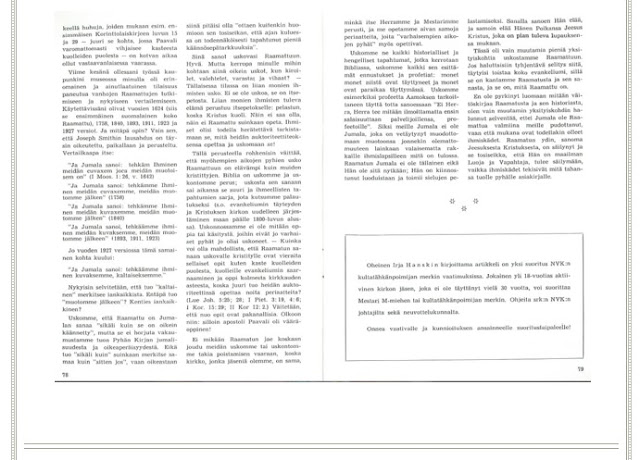
Here’s the article from the magazine, written in 1963, just before I graduated from high school. The article was one of the requirements for—have you heard of this?—the Golden Gleaner Award which I received. Part of the reason for the research and writing was my hope that the missionaries would find the article useful, but it is possible that the language was too high-flying. Even then, and especially then, since it was Finnish, my mother-tongue, I was quite verbose.